
When people ask us about a fence for dogs in The Woodlands, they usually start with height. Height matters for a few dogs, but it’s rarely where the escape happens. Most dogs get out under the fence, through a gate someone left unlatched, or by climbing something sitting next to the fence line.
So we plan a dog fence from the ground up: the bottom first, then the gates, then the height. Here’s how that works on lots in The Woodlands, Porter, New Caney, and Splendora.
Start at the bottom
Why the ground here makes digging easy
Most lots in this part of Montgomery County have a good layer of sandy or fine sandy loam on top, often 18 inches or more before you reach the clay underneath. It’s soft, it drains fast on top, and a determined dog can move a lot of it in an afternoon. Heavy rain also washes out low spots along a fence line, opening a gap that wasn’t there last month.
What we do about it
- A rot board along the bottom. A 6-inch board at the base closes the gap under the pickets. In The Woodlands, a rot board up to six inches is approvable, so it fits most designs.
- A dig barrier below grade. For diggers, we add a barrier along the base of the fence so a dog that starts a hole hits something it can’t get through.
- Set posts to stay put. On the flatter lots near The Woodlands, Porter, New Caney, and Splendora, clay sits closer to the surface and water perches on it in wet months. Post holes can slough in or fill with water. We never pour concrete into a wet hole. We pump it out, add a gravel base, and set the post. A post that leans opens a gap at the bottom, and dogs find gaps.
Gates are where most dogs get out
A fence is only as good as its gates, and gates get opened every day by kids, lawn crews, and meter readers.
- Self-closing, self-latching hardware. The gate swings shut and latches on its own, so one forgetful moment doesn’t turn into a neighborhood search.
- The latch out of reach. Some dogs learn to nose up a lever latch. Mounting it high or on the outside fixes that.
- A tight gap underneath. Gate bottoms clear the ground so they can swing, and small dogs squeeze through that space. We keep it tight and check that the ground under the swing is level.
- A gate post that won’t sag. When a gate post moves, the latch stops lining up, and the gate stops closing. Our gates page covers hardware and post options.
Height, climbing, and what’s beside the fence
For most dogs, a 6-foot fence is plenty. A real jumper may need more, and in The Woodlands a solid fence can go up to 7’6” on most lots. See-through fences top out at 6’6”.
Climbers are a different problem. On a wood fence, the finished side faces the street or neighbor, so the rails face your yard, right where your dog is. Some dogs use them as a ladder. A taller fence helps, and so does keeping AC units, woodpiles, benches, and the trash can a few feet off the fence line.
Wood or steel for a dog fence?
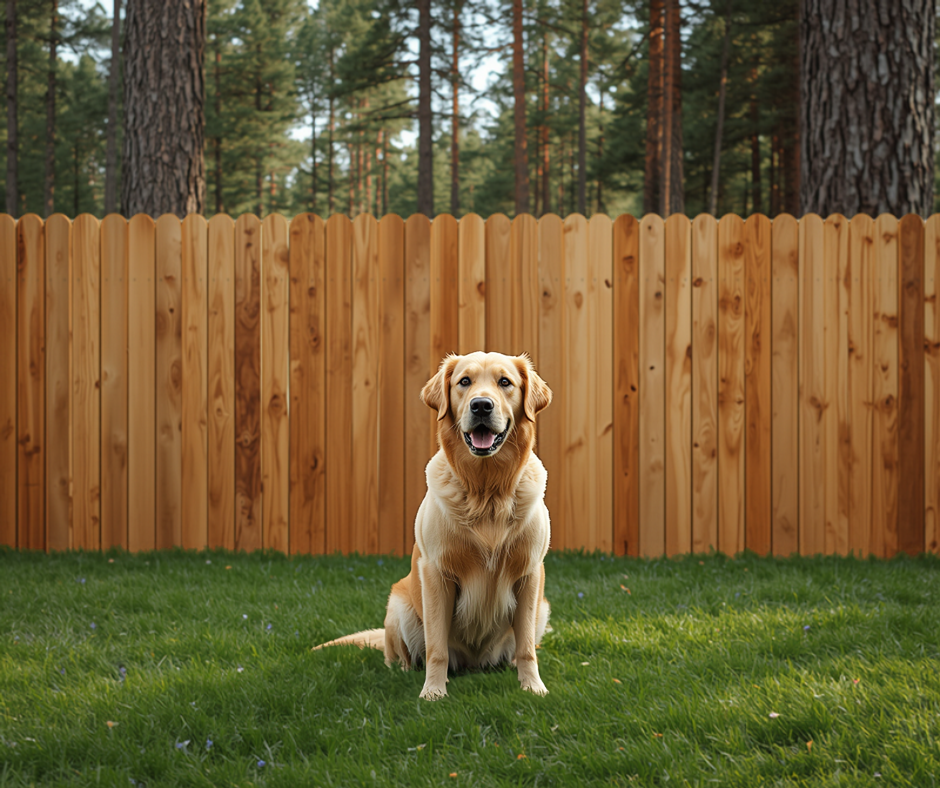
Solid cedar blocks the view of squirrels, deer, and the dog next door, which cuts down on barking and fence-running. That’s why it’s the most common pet fence we build.
Ornamental steel is the answer where a solid fence isn’t allowed, like the rear line of a golf course or lake lot in The Woodlands. Standard picket spacing can let a small dog slip through, so we add puppy pickets, tighter spacing along the bottom. Steel also holds up to a big dog hitting it at a run. Our ornamental steel page has more.
Vinyl and unscreened chain link aren’t allowed inside The Woodlands, so we don’t recommend them there.
What the Township allows for pets
- Pet fences need approval. Short interior fences are normally pre-approved, but not when they hold an animal.
- Dog runs go in the back or side yard, at least 3 feet from a perimeter fence next to another home, and no taller than 6 feet or the fence beside them. Chain link is allowed for a run only when a solid fence fully hides it.
- Mesh on iron fences: black mesh up to 3 feet tall can go on the inside of a wrought iron fence, but only for six months or less.
Outside the Township, your HOA’s deed restrictions usually set style and height. Our pet fence page covers more options.
Planning a fence for your dog?
Tell us whether your dog is a digger, a jumper, or an escape artist. We’ll walk the line, find the weak spots, and price a fence built around it. Request a free estimate or call (713) 331-9385.
Pet fence, dog run, height, and mesh rules summarized from Sections 2.4 and 2.6 of The Woodlands Township's 2024 Residential Development Standards (recorded December 10, 2024). The recorded standards and your Neighborhood Criteria control, and they can change.