

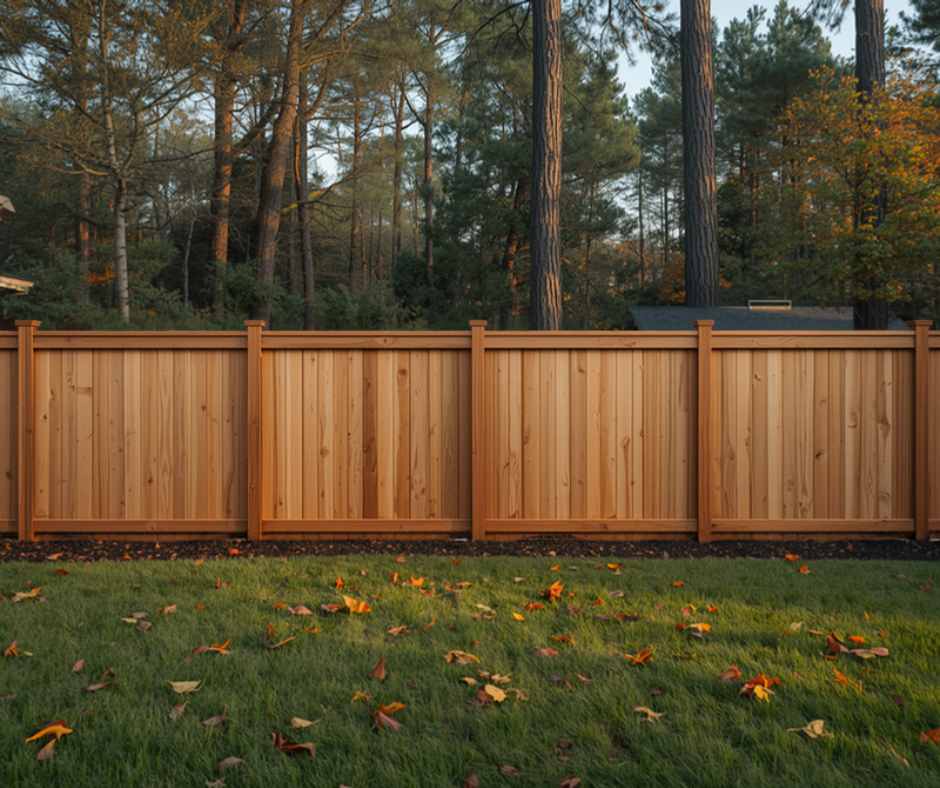
A builder-grade fence does one job: it closes in the yard so the house can sell. It’s built to a budget, often by a crew moving down a whole street, and it usually looks fine on closing day. A year or two later, owners start calling us because the gate drags, a section leans, or the yard was only fenced on two sides.
If you’ve moved into a newer home in The Woodlands, Porter, New Caney, or Splendora, here’s how we look at a builder-grade fence and decide whether to extend it, upgrade it, or start over.
What makes a fence builder-grade
Builder fences vary, but the ones we see most often have a few things in common:
- Two rails instead of three, so pickets have more room to cup and warp.
- No rot board, which leaves the bottom of every picket sitting in damp soil and mulch.
- Nails that rust and leave streaks down the pickets.
- Posts set as fast as the schedule allowed, without much thought about depth or wet ground.
For comparison, our standard wood fence uses three rails, a 6-inch rot board, galvanized ring-shank nails, and posts at least 24 inches deep with 80 pounds of concrete each, deeper in loose or wet ground. Those details don’t show on day one. They show after the second wet winter.
Check the posts before anything else
Pickets are cheap to replace. Posts decide whether the fence is worth keeping. Push on the fence every few posts. If it moves at the ground line, or the gate no longer lines up with its latch, the posts are already letting go.
The ground is part of why. On the flatter lots around The Woodlands, Porter, New Caney, and Splendora, a layer of sandy loam sits over a clay subsoil that comes closer to the surface than it does on higher ground. In wet months, water perches on that clay, and post holes slough in or fill with water. We never pour concrete into a wet hole. We pump it out, put gravel in the bottom, and then set the post. A post poured into standing water is the one that leans first.
Three ways to go
Extend and match
If the posts are solid and the yard just isn’t closed in, we extend the existing fence and match its height, style, and picket pattern. New cedar will look brighter than the old fence for a while, so plan on staining the whole thing once the new wood has dried.
Rebuild on the posts that are good
When the posts are sound but the pickets are warping or the bottom is rotting, a partial rebuild can make sense: add a third rail, a rot board, and new pickets. This only works if the posts are worth building on, so we’ll tell you honestly when they aren’t.
Replace it with a fence built to last
If the posts are moving, rebuilding on them is wasted money. A full replacement lets you pick a better style and better posts in one step. The most common upgrade we build is capped board-on-board cedar on galvanized steel posts. Our privacy fence page covers the styles, and our steel vs. wood posts guide explains why steel holds up better in wet ground.
Get approval before you change anything
A builder fence was approved as part of the house. Your changes need their own approval.
- In The Woodlands, any new fence, and any repair that replaces more than eight linear feet, needs written approval from your village’s Residential Design Review Committee. That includes newer villages like Creekside Park. Vinyl and unscreened chain link aren’t allowed, and the finished side faces the neighbor or the street. Our approval guide walks through the steps.
- In Porter and New Caney, nearly every master-planned community, from Valley Ranch to The Highlands, has its own fence guidelines and architectural review. Many specify a style and stain color, which makes matching easier.
- In Splendora, we confirm city requirements for addresses inside city limits.
Upgrades that pay off
- A third rail and a rot board. Small cost, big difference in how straight the fence stays.
- Steel posts on any new run, especially on low, flat lots that hold water in winter.
- A real gate post. Most gate complaints start with a post that was never meant to carry a gate.
- A cap. It sheds water off the picket tops and gives the fence a finished line. In The Woodlands, a cap adds two inches of allowed height.
- Stain once the wood is ready, in a color your committee or HOA accepts.
Planning a builder-fence upgrade?
We’ll walk the fence, check every post, and price the options side by side: extend, rebuild, or replace. Request a free estimate or call (713) 331-9385.
Approval, material, finished-side, and cap rules summarized from The Woodlands Township's 2024 Residential Development Standards (recorded December 10, 2024). The recorded standards, your Neighborhood Criteria, and your HOA's guidelines control, and they can change.